The K4 research record.

We asked ChatGPT to work on Kryptos. It ruled out entire sets of keys, checked published claims, and left a reproducible trail. We did not recover the encryption method.

Download the research ↓
OBKRUOXOGHULBSOLIFBBWFLRVQQPRNGKSSOTWTQSJQSSEKZZWATJKLUDIAWINFBNYPVTTMZFPKWGDKZXTJCDIGKUHUAUEKCAR

22–34 EAST NORTHEAST

64–74 BERLIN CLOCK

Original ciphertext. Positions are counted from 1.
24 letters of plaintext are publicly confirmed.

How much was ruled out?

The K3-derived test alone excludes 4,524,029,526,974,464 parameter combinations. A contradiction between two confirmed letters can eliminate every key in a model without trying the keys one at a time.

4.52 quadrillion

Key-and-method combinations excluded by four K3-derived rearrangements, with every 8- or 10-letter key.

4 routes × 2 alphabets × 2 signs × 2 operation orders × (268 + 2610)

Independent verification ↗

204,913,783,045,357,568 further labelled assignments are covered by the binary 7 × 7 matrix proof: 364 alphabet/alignment cases, each allowing all 249 binary matrices.

The earlier columnar searches cover larger spaces still. Their complete finite accounting is below. Models can overlap, so these counts describe parameter assignments, not distinct plaintexts or independent solutions.

Full finite search accounting 6.56088 × 10^92

The sum across the ten families in this ledger is:

656,088,076,618,908,824,313,107,197,286,544,515,861,848,336,008,633,625,137,803,385,820,549,666,122,804,211,668,074,668,032

Model-labelled parameter assignments excluded. Every row retains its source summary. Equivalent keys or cipher functions can appear in more than one model; the total has not been deduplicated across families.

FamilyNegative model cellsParameter assignments
Ordinary columnar338518,454,579,766,154,252,339,121,208,833,120,690,250,873,497,093,510,325,137,732,846,885,467,299,656,221,982,720,000
Autokey columnar4321,529,022,446,773,476,595,988,542,495,064,064,000
Independent column reversal444,313,644,366,707,057,999,696,887,808,000
Mixed alphabet axes20935,514,845,880,975,360,000
Progressive keys481,872,361,385,492,742,144,000
Column-reset roots411,702,924,506,195,034,112,000
Affine substitution203,329,234,326,978,560,000
Inverse columnar, including derived periods56656,087,558,164,329,058,158,854,858,165,335,682,741,158,085,135,136,531,625,949,221,327,284,922,838,118,603,545,837,568,000
K3-derived routes644,524,029,526,974,464
Binary 7 × 7 matrices364204,913,783,045,357,568

The count omits repeated runs, the surviving width-31 model, baseline replications, and the unbounded key-length extension of the reset proof. The Berlin ring experiment is reported separately: 2,212 registered cases fail under the distinct-hour-number interpretation.

Download formulas, scope and source ledger ↗

Research tokens 8,770,028+

Six completed goals used 8,403,684 tokens. The interrupted initial run had already used 366,344 at its last recorded checkpoint. The combined figure is therefore a documented lower bound.

Research phaseRecorded tokens
Initial run, last recorded checkpoint366,344+
Main cryptanalytic campaign3,417,704
Public-source survey1,310,021
Four follow-up investigations1,128,952
Binary-matrix and archive continuation1,233,387
Berlin World Clock investigation720,361
K3-derived alternatives593,259

These are native goal usage records, not token budgets or a billing estimate. Planning, unbudgeted follow-up, and this website are excluded. The old 1.31M figure counted only the public-source survey.

What was actually tested

FamilyBounded scopeOutcome
Ordinary periodic columnarWidths 16 to 20, periods 1 to 6; width 18, periods 7 to 12; AZ and KRYPTOS alphabets, both signs and stagesclosed
Ordinary width 31Periods 1 to 5 under the same conventions36 models closed
Width 31, period 6One additive-before model with key XETQGRstructural fit only
Ciphertext autokeyWidths 16 to 20, lags 1 to 12, two alphabets and three signed conventions360 models closed
Plaintext autokeyWidth 18, lags 1 to 12, same conventions72 models closed
Mixed axes, progressive, reset, affineDeclared fixed schedules and finite parameter cells documented in the reportbounded negatives
Inverse columnarSource and destination phase models with local certificates, plus exact source-phase period 4 closuredeclared cells closed

A negative result applies only to the stated alphabet, period, route, operation order, and clue alignment. It does not close the named cipher family.

Audits of published claims

Each finding applies to a stated model or implementation. The linked reports preserve the equations, source references, and verification.

Published binary 7-by-7 hypothesis

A fixed binary matrix model proposed in Richard Bean's 2018 notes was tested against the newer EAST, NORTHEAST, BERLIN, and CLOCK plaintext. All 364 registered alphabet and alignment cases were rejected, including the 99 cases that survived the first partial gate.

Invalidatedthis fixed model under the registered boundsStill openother matrices, alphabets, affine terms, feedback, and transposition

Displayed spatial shift array

A separate public proposal displayed a 97-position shift array beside its ciphertext and candidate plaintext. Direct A=0 arithmetic disagreed at 75 of 97 positions. Two independent implementations matched.

Invalidatedthe displayed array for the proposal's stated inputsStill openspatial mechanisms with independently measured inputs

Experiment 015 exclusion argument

Inspection found transformed clue constraints applied incorrectly and a ragged-grid mapping that dropped real cells while admitting invalid indices. A planted counterexample was rejected by the published formulas.

Invalidatedthat implementation's claimed coverageStill openthe broader substitution-plus-columnar family

Bean constraints under arbitrary permutations

A literal fitted counterexample refuted the blanket extension of direct-alignment Bean constraints through arbitrary permutations. The counterexample is a proof defect, not a K4 candidate.

Invalidatedthe blanket extension argumentStill opencorrectly constrained permutation models

The width-31 survivor

The width-31, period-6 model produced a witness using the key XETQGR. It reproduces all 97 ciphertext letters and matches all 24 disclosed plaintext letters.

The remaining 73 letters are incoherent. Nine clue-free columns can also be rearranged in 362,880 ways without breaking the disclosed clues. There is no source-derived reason to prefer this witness, so it remains a structural fit and nothing more.

known letters24 / 24 undisclosed textincoherent intended solutionno

The historical World Clock

established

BERLINCLOCK refers to the Urania World Clock at Alexanderplatz. The shaft map and the drum have a documented vertical city-to-time-zone relationship.

missing

No acquired plan fixes the pre-1990 city-sector order to geographic north. Modern labels are unsafe because a 1997 restoration added 20 city names and changed time-zone treatment.

admission gate

Acquire a dated plate schedule or north-referenced drawing before testing another period-24 city stream. Unknown historical cells must remain unknown.

Where to continue

  1. Audit physical selectors without fitted values

    Build a dependency graph for every constant in a proposed clock, compass, or sculpture decoder. Label each value measured, conventional, crib-derived, or plaintext-fitted. Test only what remains predictive.

  2. Reconstruct the pre-1990 World Clock input

    Obtain dated evidence for the exact sectors or labels consumed by one declared extraction rule. Do not require an entire 80-city inventory when a narrow rule uses fewer cells.

  3. Test one literal K0-to-K3 instruction mechanism

    Select the operations from source evidence before running K4. Replay them against established examples and matched synthetic messages.

  4. Choose one Egypt or Berlin source before choosing a key

    A dated travel document, object, or message convention can justify a finite extraction. A large topical word list cannot.

  5. Reopen a classical family only for a demonstrated gap

    State the closest prior attempt, exact unsearched cell, source for the difference, finite bounds, success gate, and stopping rule before execution.

candidate gate

Require an exact 97-character round trip, all 24 disclosed letters, coherent text outside the clues, an independently motivated route and key, and independent verification. A necessary survivor is not a plaintext candidate.

Reports and reproducible tests

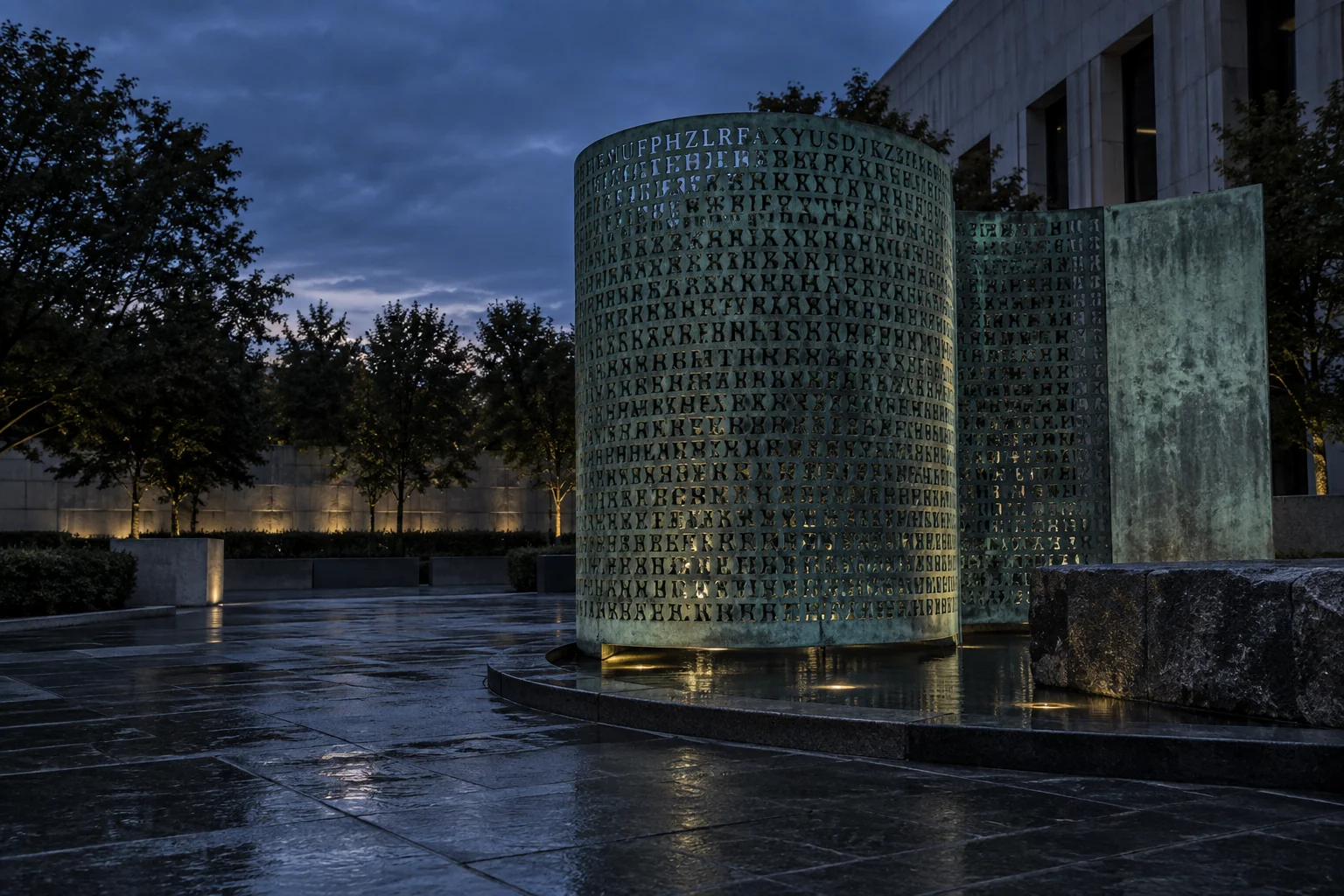
The sculpture

AI-generated interpretation of the Kryptos copper sculpture at blue hour.
Generated sculpture image for the video. The cut-out lettering and setting are illustrative.

Kryptos was installed at CIA headquarters in 1990. Its fourth passage contains the 97 letters shown above.

Plaintext was found in archival material in 2025. That discovery is separate from independently reconstructing the encryption method, which this campaign did not achieve.

Read the archival discovery report ↗